A Man Apart
At Holy Cross Cemetery

I’ve always loved cemeteries. I learned to drive in one. Valhalla Cemetery, in Milwaukee, Wisconsin, sometime in the 1970s. It was safer that way, no one could get run over. Some of my favorite cemeteries are in New Orleans with its above-ground crypts, Italy and France with their beautiful tombs, England with its gothic cathedrals and ancient gravestones, and the stark beauty of a desert graveyard with mountains as the backdrop.
On a recent trip to visit family in South Bend, Indiana, my partner and I decided to take a walk on the grounds of the University of Notre Dame. It’s a lovely campus, with beautiful old buildings, woods full of old gnarly oaks and sycamores, and two large lakes with scenic walkways. Off the beaten path, we came across a small cemetery named Holy Cross Cemetery, the final resting place of the brothers and priests of the Congregation of Holy Cross, which founded the university in 1842. The graves date from the present era back to that time.
In this cemetery, all the grave markers are the same. Simple stone crosses on a small stone base, all identical, except for the name and date of death. Perfectly spaced in rows and columns, markers all the same height, none standing out from the others. This arrangement of graves is evidence of the order’s commitment to the Christian vow of humility. The commitment included living a life of poverty, chastity, obedience and support for each other and their community.
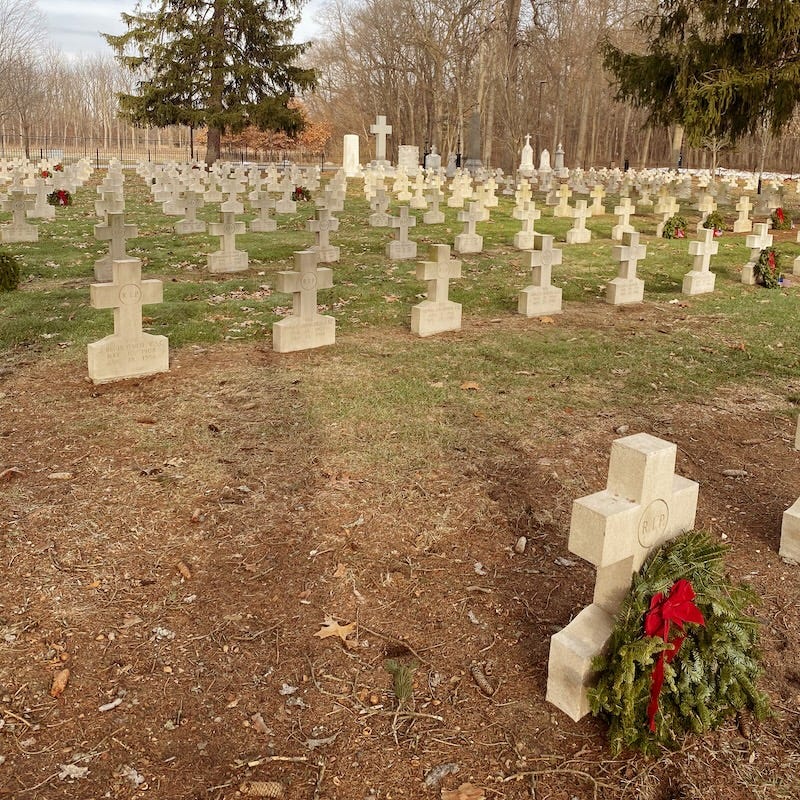
As a curious person, I wondered if any of these men regretted their generic grave markers once they were in the spirit realm. What if they wanted to be remembered for their fondness of Guinness, their musical talents, or maybe they wrote a great book? Some of them were accomplished baseball players. But no, in the cemetery everyone was an equal. Somehow this bugged me. And maybe it bugs them too. I believe our individuality goes with us into the afterlife, and these brothers and priests were all unique individuals. Perhaps they still maintained in spirit who they were in life. I decided that I would come back to this cemetery and spend some time alone there. Walk the graves and see if any spirits had something to say to me.
A month later, we were back in the old cemetery. The weather was unseasonably warm and still. It was Christmas Day. We split up so I could have some time by myself. I walked up and down the paths between the gravestones.
I came upon an old tree in the front of the cemetery near the road. This tree still had its rusty colored fall leaves, even though almost all the other trees nearby were bare. As I stood there thinking about what it may have been like to dedicate your life to a religious order, I mused out loud, “The idea of celibacy isn’t natural.” Immediately the tree branches above me began to blow strongly in the wind. Except there was no wind. No other tree moved an inch. My hair didn’t blow in the breeze. Then, as suddenly as the wind started blowing, it stopped.
Maybe this was a message from the brothers and the priests. Did they agree with me or not? The feeling I got was not welcoming. A woman tromping around on their sacred ground complaining about celibacy may be upsetting to them. Perhaps they were happy with their chosen earthly path. It is not one I understand. Perhaps their bonds of solidarity required that none of them would speak up when they were all together like this, especially to an intruder.
I continued to wander along the rows of graves for a while, noting the various names of each person. In the front of the cemetery, I noticed a flat stone in the grass. At first, it looked like some sort of steppingstone or flagstone to walk on. But something about this stone seemed special. Half of it was covered in mud, so I used the tip of my shoe to rub off dirt from the flat surface. As I did so, I realized there was writing engraved in the stone.
As the mud was removed, a name became visible. Jas. McLain, 15th U.S. Infantry. There were no years engraved on the stone. This seemed to be a very old grave. Restoring the man’s name to full view somehow made me feel happy. Merry Christmas to this man. I wondered who he was and why his grave was different from all the rest.
As an amateur genealogist, I couldn’t help myself. When we arrived back home after our visit, I did a search on ancestor sites for Jas. McLain. Jas. is an abbreviation for James. There were many people with the name James McLain, but none in South Bend.
On Findagrave.com, searching by cemetery name, nothing turned up. Then I tried looking up the names of those buried in this cemetery on the Notre Dame website. There was a list, along with a picture of their gravestones. I painstakingly looked through the list and finally found a picture of the flat stone grave marker. It turns out, the stone was only one part of this person’s grave. About three feet way, facing the flagstone but turned in a different direction from all the other markers, was a stone cross with the name Jas. McLain on it. Just like the flagstone. These two gravestones went together.
This was the grave of brother Leander (James) McLain. He had been a soldier in the Civil War. He was born in Pottsville, Pennsylvania in 1842 and died in 1911 at 68 years of age. When James McLain was 23 years old, he enlisted in the army for three years of service in the 15th United States Infantry. He took part in General Sherman’s infamous March to the Sea. Along the way, he took part in many battles, suffered fatigue, and at times, a scarce food supply. He came through the horrors of war, with a strong dedication to his fellow soldiers, church and country, (according to the Notre Dame archives). After the war he joined the brothers of the Holy Cross at Notre Dame, where he became a teacher and was known as “Comrade.” He was also a commander of Notre Dame G.A.R. (Grand Army of the Republic), a veterans group dating from the Civil War. The Notre Dame chapter was comprised solely of priests and brothers of the Holy Cross.
James McLain was well liked by his fellow brothers and students. He was considered a cheerful and humble man. Although he did have two grave markers versus the one everyone else had. His funeral in 1911 was one of the largest and most well-attended at the University in many years.[1]
Brother McLain seemed like an all-around good guy. The Catholic Church has had its share of terrible scandal, so I was glad to learn about him. Perhaps discovering his multiple grave markers answered my question. Someone, maybe James McLain himself, wanted more fanfare beyond a simple stone cross.
[1] University of Notre Dame Archive